We're Cousins
"Each of you brings something unique and beautiful to our family, and together, we create a tapestry of connection, care, and unbreakable unity." (author unknown)

This morning I was feeling puny. As I listened in to my thoughts, clearly they were not helping. Catastrophizing. It goes...this-thing-is-not good-and-this-not-good-thing-means-more-not-good-things-are-going-to-happen-even-worse-not-good-things.
It took a bit of effort to pull myself out of the downward spiral. It helped to get pics and stories from family members visiting Philly. Hearing about their joy in re-living our American history.
John helped by his presence and by jogging my memory of some delightful and surprising encounters with different sorts of people at our weekly community meal. There were the mentally challenged people singing all the words to John Denver’s Take Me Home, Country Roads holding hands with others, the hard-right and hard-left folks sharing cookbooks, the weird folks we were afraid of who came to the meal and turned out to be beautiful souls and capable hands.

Then I started thinking about a kayaking adventure and lunch we shared with some good friends on Monday. We were doing a bit of commiserating over various topics when one of them started talking about the world cup. The stories made me smile. She said, “We really needed this as a country and as a world.” I was thinking how I needed them personally.
I haven't watched much of the FIFA World Cup this year. But after listening to my friends, I took time to read an essay by Andrew Sullivan this morning. He shared some of the stories emerging from the tournament, I found myself smiling—and even feeling hopeful. Beneath the competition is another story unfolding. It is a story about our remarkable ability to see one another not as enemies or strangers, but as fellow human beings.
Here are a few that particularly moved me.
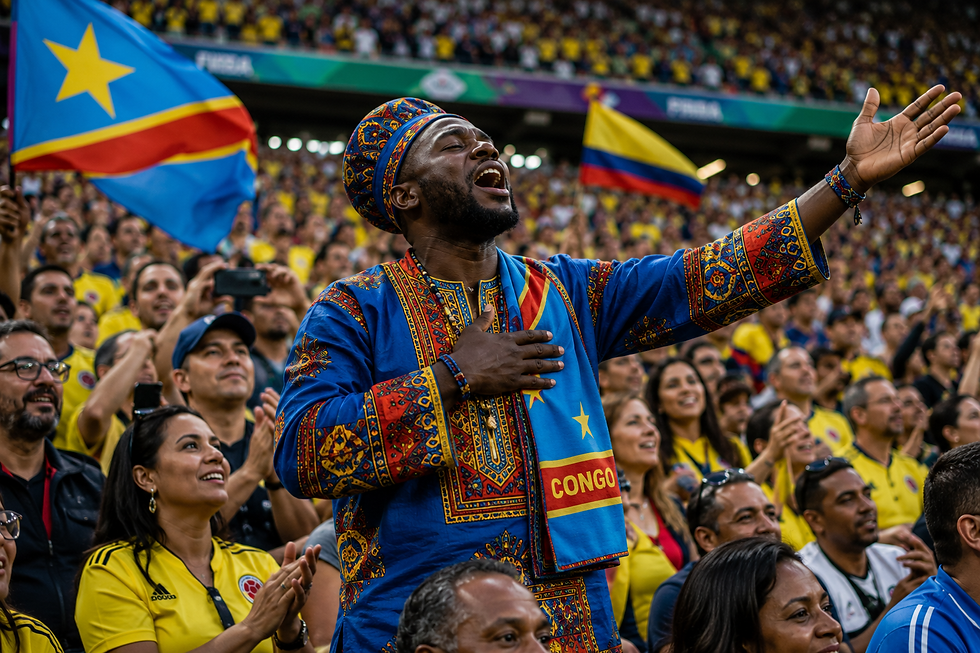
A stadium full of cheering Colombians suddenly became quiet as a single supporter from Congo stood alone and sang his country's national anthem. When he finished, the Colombian crowd erupted in applause. For just a few moments, nationality gave way to shared humanity.
Then there were the Scottish fans. After Scotland was eliminated, many of them simply adopted Morocco as "their team." As Sullivan observed, you could almost feel the supporters shifting their allegiance to "another plucky underdog from halfway around the world." Competition gave way to admiration. Evidently the Scots took a party with them wherever they went.
The Norwegians brought their own unforgettable tradition. Thousands of fans sat together, pretending to row like Vikings. Soon they weren't just rowing inside the stadiums. They were rowing through airports, city streets, and even on a New York subway, inviting everyone nearby to laugh with them.
In another beautiful moment, Iraqis chanted alongside Scots playing bagpipes. Mexican fans joyfully tossed a lone Korean supporter into the air. In Seattle, supporters from Bosnia-Herzegovina celebrated beside fans from Qatar.

None of these people had to become alike to enjoy one another. Their differences became something to celebrate instead of fear.
One of my favorite stories came from Lawrence, Kansas.
Nearly 300 local residents waited in the rain late into the night simply to welcome Algeria's national soccer team. The welcome didn't stop there. A local artist created a giant earthwork of the Algerian flag, and the University of Kansas band learned Algeria's national anthem so they could perform it during the team's open practice.
Imagine arriving in a foreign country and discovering that strangers had learned your national song simply to make you feel at home.
That is hospitality. (Click the previous underlined link to see what I mean.)
Perhaps the most uplifting story came from a Haitian-American family attending the Haiti-Scotland match. Scottish fans approached them for a photograph. During the conversation they discovered the family's great-grandfather had been Scottish. The response was immediate and joyful:
"We're cousins!"
Soon Scottish drinks were being exchanged for Haitian rum, kilts were dancing to Haitian percussion, and complete strangers had become family for an afternoon.
I couldn't help thinking that this is what Jesus seemed to be doing wherever he went.
He was constantly enlarging people's circle of belonging. Samaritans. Romans. Tax collectors. Fishermen. Women. Pharisees. Children. Outsiders. Again and again, he gently challenged the question, "Who belongs to my tribe?" and replaced it with another question: "Who is my brother or sister?" The question at the heart of Christianity.

Modern psychology tells us something similar.
Human beings are naturally tribal as Andrew Sullivan points out. We instinctively form groups. That isn't necessarily bad. Families, churches, neighborhoods, and communities all depend upon healthy belonging.
The danger comes when our identity depends on someone else becoming "the other."
The World Cup offers another possibility.
For ninety minutes folks cheer passionately for their own team. Then the whistle blows, and suddenly people who were rivals are exchanging scarves, taking photographs together, singing one another's songs, sharing food and stories, and discovering they have more in common than they ever imagined.
Perhaps that is why these stories have touched so many hearts.
They remind us that beneath our flags, languages, politics, religions, and cultures, we share something deeper. We laugh. We hope. We suffer. We celebrate. We belong to each other.

Most of all I love that we humans, if you are like me, are morally inspired by these stories. Moved to tears. That’s one of the pieces of evidence I have for God still alive and well in us.
Here are three things I’m going to try this week to pull my out of my puny self as a preventive measure and as avenues to personal and collective joy, growth, and relational flourishing (John would want me to boldly add LOVE).
First, start a conversation with someone whose life experience is very different from mine. I have many opportunities for this at the community meal.
Second, purposely attend a community gathering where people of different backgrounds come together – I know I’m already doing that, but keep it up and use that opportunity well. Think how I might symbolically exchange gifts.

Third, the next time I find myself thinking in terms of "us" and "them," pause and ask, What story about this person have I not yet heard?
And I'm going to remember the most inspiring words spoken during this World Cup event were not the ones after a goal. They were spoken by a group of delighted Scots who had just discovered distant family in the most unexpected place.
"We're cousins."
How might we get out of our puny selves and catastrophic thinking, and embrace the God within us by expanding our circle until there are fewer strangers—and many more cousins and journey together to The Good Life?
P.S. I was telling a Pastor friend of mine about the community meal and the folks holding hands and singing Take Me Home, Country Roads. She said, "I can't think of a better description of a good church meeting."
AND if you want to fall more deeply in love with America, this is a wonderful little article from the BBC on the America the World Cup fans were not expecting to love. Click here.
And in general terms, it's a good thing to take note of where our attention is when we notice we are feeling "puny" or headed in that direction. A kid's song helps me. You've probably sung it:
Oh be careful little eyes what you see...
Oh be careful little ears what you hear...
Oh be careful little feet where you go...
Oh be careful little hands what you do...
Oh be careful little tongue what you say...
Oh be careful little head what you think...
I hope you will find here stories, research, personal experiences and reflections to forward your journey to flourishing.


Comments