"The Blessing" - 12 Lines That Could Boost Us to The Good Life...If We Use Them
Updated: Sep 2
“Be mindful of intention. Intention is the seed that creates our future.”—Jack Kornfield
How did I get to this place of writing a lengthy intro to a story and a 12 line (4 sentence) “blessing”?
(But before I even go there, be assured there are shortcuts to this blog if a thirty minute investment is too much for you.)
Recently, I watched a grandmother cry for her grandchild, who had been mistreated during the first week of school. I also heard about a boy who had already been in two fights during that same first week.
I found myself thinking about everyone involved: the child who was hurt, the grandmother who could not protect someone she loved from every cruelty, the boy who fought, the children he fought, the worried parents, and the teachers trying to understand what had happened. Each person was carrying something. Each person was acting out of a mixture of hurt, fear, love, anger, hope, and unfinished growth.
I began tweaking this blessing—I have been crafting and reciting it in various forms for years—in response to those children. But I soon realized it was not only for them. It was for the grandmother too. It was for parents, teachers, congregations, and communities. It was for anyone who has been hurt, anyone who has hurt someone else, anyone who has failed, and anyone still trying to become a wiser and kinder human being.
It is definitely for me... and for all of us desiring to live a good life, to flourish.
[Here's your first chance to take a shortcut if you don't want to know the research and thought undergirding the blessing. Skip ahead to the story, The Blessing. AND If that story looks too long, just read the captions or look at the illustrations... or if stories aren't your thing, go directly to "The Blessing poster" at the very end. Just copy and paste it, print it out. Put it on your wall or in your pocket.]
For those of you who are in for the long haul, let's consider: What is a blessing? A blessing is not a prediction that everything will turn out well. It is a spiritual intention. It gathers our attention around what we most deeply hope for and how we aspire to live. When we recite a blessing, we plant certain possibilities in the mind and heart. It can be aimed at ourselves. It reminds us what we want to notice, what we want to value, how we hope to respond to difficulty, and who we are still trying to become. Or it can be aimed toward others.
This blessing belongs to the ancient family of loving-kindness practices. For centuries, people have repeated phrases such as “May I be happy. May I be peaceful. May I be strong,” and then extended those same intentions to others. The power of the practice is in gathering our attention around the words and gently returning to them.

Modern research suggests that this kind of intentional repetition can strengthen positive emotion, compassion, social connection, and helpful behavior. Favorable research has already been quantified on loving-kindness "meditations" which this blessing is also.
Research on affirming our central values also finds that remembering what matters most to us can make us less defensive and more open to constructive change. The words do not control our behavior, but they can make certain responses easier to notice and choose.
The blessing begins, “May you be healthy. May you be happy. May you be grateful. And may you know you are loved.” Just saying those words repetitively makes a difference.
The first word I chose was “healthy,” - it often begins ancient loving-kindness meditations and it deserves more attention than we usually give it. In conversations about well-being, we sometimes become so interested in happiness, gratitude, meaning, and purpose that we treat physical health as merely the platform upon which the more interesting parts of life take place.
In medical settings, we can make the opposite mistake: we focus on organs, symptoms, laboratory results, and disease while overlooking emotional, cognitive, social, and spiritual health.
A human being cannot be divided so neatly.
The World Health Organization has long defined health as more than the absence of disease. It includes physical, mental, and social well-being. More recently, researchers and health professionals have increasingly spoken of “whole-person health” and a biopsychosocial-spiritual understanding of the person. These approaches recognize that our biological, emotional, cognitive, behavioral, relational, environmental, and spiritual lives continually affect one another.
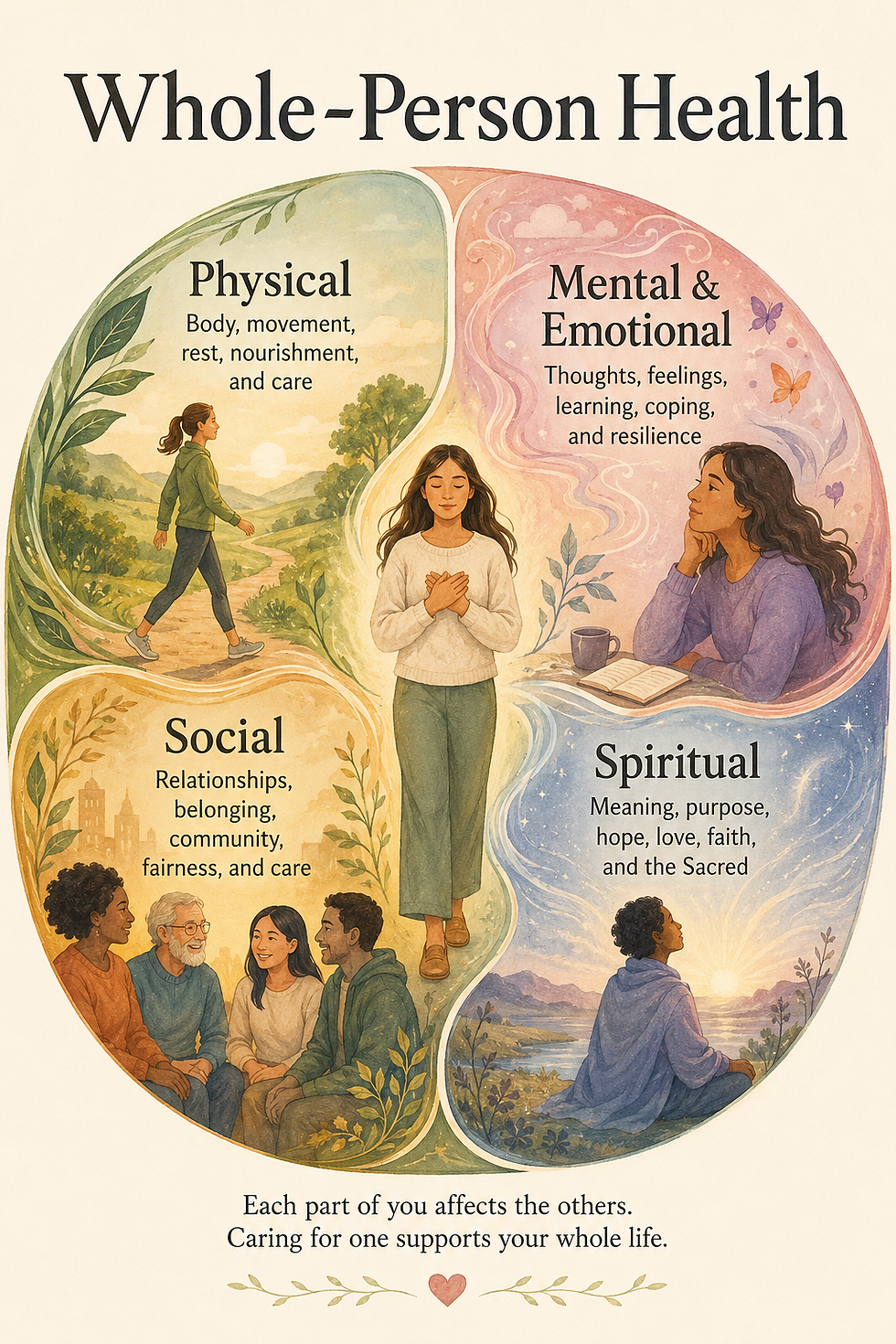
Fear can tighten the body and interrupt sleep. Chronic loneliness can affect stress hormones, inflammation, and cardiovascular health. Physical illness can cloud thinking, change mood, restrict relationships, and shake spiritual beliefs. At the same time, loving relationships can help regulate stress. Purpose can motivate us to care for our bodies. Spiritual practices can provide meaning and calm. Movement can improve mood and cognition. Rest can increase patience and emotional control. None of these dimensions exists in isolation.
“May you be healthy” is therefore a blessing for the whole person. May your body receive nourishment, movement, rest, safety, and appropriate medical care. May your mind remain curious and able to learn. May you understand and tend your emotions rather than being ruled or shamed by them. May you have relationships that support life rather than diminish it. May your spirit remain connected to meaning, wonder, love, and the Sacred.
Health does not mean that every part of us will always work perfectly. If health required complete physical, mental, and social well-being, many people with disabilities, chronic illnesses, grief, trauma, or the ordinary limitations of aging would be told that a good and healthy life was unavailable to them. That is neither accurate nor humane.
Some health scholars therefore describe health more dynamically as the capacity to adapt and manage life’s physical, emotional, and social challenges. This understanding makes room for people who live meaningful, contributing, loving lives while also living with illness, disability, pain, or cognitive change. A person may require insulin, use a wheelchair, live with depression, forget things, or need substantial help and still possess humor, wisdom, love, purpose, spiritual depth, and the capacity to experience well-being.
This is also why health should never be treated as a measure of virtue. People do not earn health by being good, nor is illness evidence of personal failure, insufficient faith, or a poor attitude. Our health is shaped by genetics, accidents, aging, trauma, pollution, poverty, discrimination, access to care, safe housing, nutritious food, supportive relationships, and many other circumstances beyond individual control.
The blessing is not saying, “May you make all the right choices so that nothing bad happens to you.” It is saying, “Your whole life is worthy of care.”
There is still an invitation within it. We cannot control everything that affects our health, but most of us can participate in caring for it. We can sleep when we are tired, move in ways our bodies allow, seek help when something is wrong, nourish ourselves, learn emotional skills, protect our minds from constant overstimulation, tend our relationships, and make room for silence, prayer, beauty, play, and joy.
Health is both personal and communal. When a group or community or organization says, “May you be healthy,” it should hear a responsibility within its own words. Will we help create a community in which people are safe, included, fed, supported, listened to, and able to receive care? Will we notice the person who is overwhelmed, isolated, grieving, hungry, or unable to obtain treatment? A blessing becomes more truthful when the people offering it are willing to help create the conditions it names.
The blessing begins with health because everything in us is connected. Physical energy helps us contribute. Emotional regulation helps us become kinder. Cognitive health helps us learn from failure. Relationships remind us that we are loved. Spiritual health helps us find meaning and remain open to the Sacred. Purpose, in turn, gives us reasons to care for our lives and keep participating in them.
“May you be healthy” does not mean, “May nothing ever hurt.” It means: May every dimension of your life receive care. May you have the resources and support to adapt when life changes. May you honor your body without being defined by it. May you seek wholeness even when perfect wellness is impossible. And may you know that your life retains its sacred worth in sickness and in health.
The blessing continues, “May you be happy. May you be grateful. And may you know you are loved.”
These simple words express some of the strongest findings in the science of well-being.
Gratitude practices can improve well-being by training our attention to notice that trouble is not the whole story. Gratitude does not ask a mistreated child to pretend that nothing happened. It does not tell a grieving grandmother to look on the bright side. A person can be grateful and angry, grateful and frightened, grateful and heartbroken. Gratitude makes room for the good without denying the painful.
Shawn Achor recommends several practices drawn from positive-psychology research: naming three specific things for which we are grateful, writing about a positive experience, exercising, meditating, performing an intentional act of kindness, and investing in relationships. We can hear all of them within this blessing—health, happiness, gratitude, attention, kindness, love, and contribution.
Achor’s larger message is that we often have the usual formula for happiness backward.
We assume that if we achieve enough, solve enough problems, or finally become successful, then we will be happy. But every time we reach one goal, another appears. Positive emotion is not merely a reward waiting at the end of achievement. It can also help us think more flexibly, see more possibilities, connect with others, and act more effectively along the way.
This does not mean we should expect ourselves to be cheerful all the time. Sadness, anger, fear, and grief carry information that needs to be heard. Positive psychology at its best does not ask us to paste happiness over suffering. It asks us to build the inner and relational resources that help us meet the whole of life.
The following line: “May you know you are loved” may be the most important intention of all. Research consistently shows that belonging and supportive relationships are fundamental to mental, emotional, and physical health. Knowing that someone sees us, cares what happens to us, and will remain with us through difficulty helps us face what we cannot face alone. This includes accepting ourselves as “the beloved” of a Cosmic, benevolent force if we are walking a spiritual path.

That message is needed by the child who was mistreated. It is also needed by the child who fought. Telling someone that they are loved does not excuse harmful behavior. Love tells the truth, establishes boundaries, protects people from harm, and asks for repair.
But love also refuses to reduce a human being to the worst thing that person has done.
The next words are, “May you use your hurt and suffering to become wiser, stronger, kinder, and more open to the Sacred.”
Here we encounter psychologist Carol Dweck’s research on growth mindset. A fixed mindset tells us, “This is simply who I am. I failed, so I am a failure. I cannot change.”
A growth mindset says that our abilities, habits, responses, and even aspects of our character can continue to develop. We can learn better ways to handle anger. We can become more skillful at resolving conflict. We can ask for help, make repairs, try a different strategy, and begin again.
Growth mindset does not mean endlessly telling someone to try harder. Repeating the same unsuccessful response is not necessarily growth. Growth may require stopping, listening, resting, receiving guidance, learning a new skill, or allowing another person to help us see what we cannot see alone.
The blessing also does not claim that suffering is good or that it automatically improves us. Hurt can make us fearful, guarded, and more likely to hurt others. People need safety, protection, accountability, comfort, justice, and time to heal.
Yet suffering does not have to have the last word. With support and intentional effort, hurt can deepen our compassion. Failure can teach humility. Disappointment can redirect us. Regret can lead to repair. Questions without easy answers can make us more open to mystery and to the Sacred.
This possibility is reflected in the research on post-traumatic growth. Psychologists Richard Tedeschi and Lawrence Calhoun use that term to describe positive changes that some people report through the struggle with highly challenging circumstances. These changes can include a greater appreciation of life, deeper relationships, a stronger sense of personal strength, new possibilities, and spiritual or existential growth.

Post-traumatic growth does not mean that trauma is good, necessary, or secretly a gift. It does not mean that people who remain wounded have failed to grow. Growth and distress can exist at the same time. A person may become more compassionate and still experience grief. Someone may discover new strength and still wish with all their heart that the painful event had never happened.
The growth does not come from suffering alone. It comes, when it comes at all, from the long struggle to live with what happened, make meaning of it, receive support, revise shattered assumptions, and build a life that can hold both the wound and the possibility of something new.
The words “more open to the Sacred” deserve particular attention. They are not an ornamental religious phrase added to the end of a psychological idea. Research on spirituality, religious coping, meaning-making, and post-traumatic growth suggests that suffering can profoundly affect how people understand and experience their relationship with God, a higher power, the holy, or the larger mystery of life.
Spiritual and existential change is one of the major areas identified in post-traumatic-growth research. Some people emerge from adversity with a deeper spiritual life, a changed understanding of what is sacred, a greater appreciation of life, or a stronger sense of connection with God and other people.
Others experience spiritual struggle, doubt, anger, or a loss of faith. Still others experience both struggle and deepening.
Kenneth Pargament, one of the leading researchers in the psychology of religion, distinguishes between positive and negative religious coping. Positive religious coping may involve seeking spiritual support, praying honestly, trusting that one is not abandoned, working collaboratively with God, receiving care from a faith community, or placing suffering within a larger framework of meaning. These forms of coping are associated with greater spiritual growth and, in many studies, better psychological adjustment.
Negative religious coping may involve believing that God is punishing us, that we have been abandoned, that suffering proves we are unworthy, or that our doubts make us faithless. These beliefs are more often associated with depression, anxiety, post-traumatic stress, and spiritual distress.
This distinction matters. The blessing does not say, “May your suffering prove that God has a plan,” or “May you accept everything that happens as God’s will.” Those words can increase guilt, silence honest grief, or contribute to spiritual injury. Instead, it says, “May your suffering make you more open to the Sacred.”
Openness leaves room for lament, anger, doubt, silence, wonder, and a changing understanding of God. Spiritual struggle is not necessarily the opposite of faith.
Pargament’s research suggests that struggle can sometimes become part of spiritual development. The questions themselves may indicate that faith is alive and being taken seriously.
A person may begin with an image of God as someone who prevents bad things from happening. When suffering shatters that belief, the person may feel betrayed or abandoned. Over time, that shattered understanding may give way to a more mature faith—not necessarily faith in a God who guarantees protection from pain, but faith in a Sacred Presence encountered within love, courage, companionship, beauty, justice, and the strength to keep going.
Psychologist Crystal Park’s research on meaning-making helps explain this process. We carry large beliefs about how the world works, who we are, what we can expect, and what gives life meaning.
Suffering can collide with those beliefs: “Good people will be protected.” “If I work hard, everything will turn out well.” “God will not let this happen.”
When experience no longer fits our assumptions, we face both a psychological and a spiritual crisis. Meaning-making is the difficult work of bringing our beliefs and our experience into a more honest relationship. Sometimes we reinterpret what happened.
Sometimes we revise what we believe. Sometimes we learn to live faithfully without a complete explanation. In that struggle, people may discover that the Sacred is larger, less controllable, and more mysterious than they once imagined.
Suffering can strip away the illusion of self-sufficiency. It may teach us that we need other people, that control is limited, and that life contains mysteries we cannot master. It may lead us into a more honest kind of prayer—not prayer that demands a particular outcome, but prayer that says, “Be with me. Show me what love requires. Help me take the next step.”
For some people, a deeper relationship with the Sacred will mean greater trust in God. For others, it may mean feeling connected to creation, humanity, beauty, justice, love, or a reality larger than the individual self. The blessing deliberately says “the Sacred” rather than defining exactly how every person must understand it. It offers an opening rather than imposing an answer.
We should also be honest about the limits of the research. Most people do not experience dramatic spiritual growth after suffering. Some experience a decline in faith or a long period of spiritual confusion. Researchers have also found that people’s perception of growth does not always correspond to measurable change over time. We should never pressure a suffering person to find God, meaning, gratitude, or a lesson before that person is ready.
That is why the blessing says “May you.” It does not say “You must.” It does not turn growth into another demand placed upon someone who is already hurting. It expresses a hope: May this pain not close your heart forever. May it not convince you that you are abandoned or alone. May it deepen your questions, enlarge your compassion, and make you more attentive to the places where the Sacred might still be found.
Perhaps the Sacred is found in the grandmother’s tears because they reveal how fiercely she loves. Perhaps it is present in the adult who protects the child who was mistreated. Perhaps it appears when someone looks beyond the boy’s fighting and asks what hurt or fear he is carrying—while still holding him accountable for the harm he caused. Perhaps it is present whenever suffering is met with truth, courage, protection, repair, and love.
Suffering is not sacred simply because it hurts. What may become sacred is the way we meet it, the love that gathers around it, the wisdom we draw from it, and the person we are still becoming through it.
Achor, working with psychologists Alia Crum and Peter Salovey, studied what they called “stress mindset.” They found that people respond differently depending partly on whether they believe stress can only damage them or whether they believe it may also call forth strength, learning, connection, and meaningful action.
This does not mean we can think our way out of trauma, injustice, illness, or dangerous circumstances. It means that our beliefs influence what we notice and what we do next.
“Nothing can be done” closes possibilities. “This is difficult, but perhaps there is one helpful thing I can do” opens a door. The blessing helps us keep that door in sight.
Then the blessing goes on, “May you know that who you are being and what you are doing matter.”
I deliberately included both being and doing. We matter before we accomplish anything. Our sacred worth does not depend on grades, employment, popularity, appearance, income, usefulness, or perfect behavior.
But what we do matters too. Our choices affect other people. We can protect or mistreat, listen or dismiss, inflame a conflict or help calm it. We can apologize, make amends, learn, and choose differently the next time.
Research on mattering suggests that people flourish when they experience both sides of mattering: knowing that they are valued and knowing that they can add value. We need to know, “My life is important,” and also, “I can make someone else’s life better.”
The blessing ends, “May you joyfully dedicate your time, attention, and talents to a cause bigger than yourself.”
This is not an attractive closing added to make the blessing sound noble. It expresses one of the most important findings in the study of a meaningful life: we tend to flourish when our lives are connected to something larger than our own comfort, success, or happiness.
Psychologist Roy Baumeister has written that a meaningful life rests upon several basic needs: purpose, a sense that our actions can make a difference, values that help us determine what is worth doing, and a sense of worth.
The final lines of the blessing touch all four. They say that our lives have value, that our actions matter, that there are worthwhile purposes to serve, and that we possess something we can contribute.
Viktor Frankl reached a similar conclusion through his work as a psychiatrist and through his suffering in Nazi concentration camps. He believed that human beings are not sustained by pleasure alone. We need meaning. Frankl wrote that meaning can be found through work or service, through loving another person or receiving something beautiful, and through the attitude we take toward suffering that cannot be avoided.
Frankl called our movement beyond constant concern with ourselves “self-transcendence.” Paradoxically, he believed that we often find ourselves most fully when we give ourselves to someone or something beyond ourselves.
A life spent asking only, “Am I happy yet?” can become painfully small. A life that also asks, “Who needs me? What do I love? What is worth doing? What can I contribute?” begins to open outward.
Contemporary purpose researcher William Damon defines purpose as an enduring intention to accomplish something that is both meaningful to us and consequential for the world beyond us. Both parts matter. A purpose must feel personally meaningful, but it must also reach outward.
Research on self-transcendent purpose suggests that people can become more persistent and resilient when their efforts are connected not only to personal achievement but also to helping their families, communities, or the wider world.
Other studies associate a strong sense of purpose with greater well-being, healthier behavior, better recovery from difficulty, and, across long-term studies, a reduced risk of premature death. Research on prosocial behavior also finds that using our resources for other people can increase happiness and connection.
We do not create the good life by chasing happiness directly. Happiness often arrives indirectly while we are loving, serving, creating, contributing, and participating in something we believe is worthwhile.
This does not require a grand mission. A cause bigger than ourselves may be raising a child, tending a garden, caring for a spouse, welcoming a lonely person, strengthening a church, protecting the earth, seeking justice, creating beauty, teaching someone a skill, or making one corner of the community more compassionate.
The blessing names three resources every person possesses. Time means, “I will show up.” Attention means, “I will notice and listen.” Talents mean, “I will discover what I can offer and continue developing it.” We may not be able to repair the whole world, but we can give something of ourselves to its healing.
The word “joyfully” is important too. Contribution is not meant to turn life into endless duty or self-sacrifice. Healthy purpose is life-giving. It connects us, calls forth our abilities, and gives us the quiet satisfaction of knowing that our presence has been useful. We are not only asking, “What do I want from life?” We are also asking, “What is life asking of me, and what do I have that might help?”

This final blessing therefore offers a powerful intention: May my life be about more than protecting and promoting myself. May I know that I have something to give. May I find joy in belonging to a good work that began before me and will continue after me.
An intention alone, however, is not enough. We may sincerely intend to be kind and still lash out when hurt. We may value gratitude and still see nothing but trouble on a terrible day.
That is why I placed the blessing inside a story. The blessing names the direction; the story lets us rehearse the journey. A principle such as “use suffering to become wiser” can remain abstract. A story shows someone being hurt, stopping before reacting, remembering the blessing, seeking help, making a choice, and taking one manageable step. We observe the process and mentally practice it alongside the character.
Research on storytelling and resilience suggests that stories can help people develop hope, coping skills, emotional understanding, problem-solving, and a sense of agency. Stories are memorable because they attach an idea to a person, an emotion, a problem, and a choice. Later, in our own difficult moment, we may remember not only the words of the blessing but also the person in the story who tried to live them.
Stories also give us enough emotional distance to examine difficult experiences safely. We may not be ready to talk about our own anger, grief, loneliness, or mistakes, but we can begin by talking about a character’s choices: “What was this person carrying? Which part of the blessing was needed? What else could the person have done?”
The characters in this story are different ages because the work of becoming does not end when childhood ends. Children, teenagers, parents, grandparents, teachers, pastors, and neighbors all experience hurt. We all make mistakes. We all need health, happiness, gratitude, love, growth, spiritual openness, mattering, purpose, and the possibility of beginning again.
The story also helps bridge the distance between intention and behavior. The blessing tells us what we value. The story helps us imagine when and how to act upon those values.
When my body or mind needs care, may I seek it without shame. When I am hurt, may I pause before striking back. When I fail, may I ask what I can learn. When I feel alone, may I remember who loves me and reach toward someone trustworthy. When life no longer makes sense, may I remain open to the places where the Sacred might still meet me. When I feel helpless, may I look for one thing I can contribute.
This blessing will not keep painful things from happening. It cannot replace protection, accountability, counseling, medical care, or changes in unjust circumstances. But it can give us words to carry when we do not know what to say to ourselves or one another.
We can say them to the mistreated child, to the child who fought, to the grieving grandmother, and to ourselves:
May your whole life receive care. May you know that you are more than what happened to you. May you know that you are more than the worst thing you have done. May you receive help, make repairs, discover your gifts, and keep growing. May you know that you are loved. May suffering deepen rather than close your heart, and may it make you more attentive to the Sacred. May you know that your life has meaning and that you possess something the world needs. May you find joy in giving your time, attention, and talents to something worthy of your care. And may you know that who you are becoming and what you do next truly matter.
The blessing, which you can see in its entirety at the end of the story, is only twelve lines. Within those lines is a great deal of good living. May we make the most of it.
The Blessing
A story about learning, loving, growing, contributing, and flourishing
On a Sunday morning in early September, everyone who entered the little church received a small card. It showed a path winding through mountains toward a sunrise. At the top were the words, “A Blessing for Life’s Journey.”
Eight-year-old Noah received one. So did sixteen-year-old Lily, forty-two-year-old Marcus, and seventy-eight-year-old Grace. Children, teenagers, parents, grandparents, visitors, and longtime members all held the same blessing.
Together they read: “May you be healthy. May you be happy. May you be grateful. And may you know you are loved. May you use your hurt and suffering to become wiser, stronger, kinder, and more open to the Sacred. May you know that who you are being and what you are doing matter. May you joyfully dedicate your time, attention, and talents to a cause bigger than yourself.”
“This blessing does not promise an easy life,” the pastor said. “It reminds us that the good life is not the perfect life. It is the life in which we keep learning, loving, growing, and contributing. When you need the blessing, change ‘May you’ to ‘May I.’”
Noah put his card in his backpack. Lily tucked hers inside her phone case. Marcus placed his in his wallet. Grace carried hers home and set it beside a photograph of her husband, Henry. Each of them would need the blessing before the month was over.
Noah’s Terrible Tuesday

Noah’s teacher asked the students to write about their summer. Noah had plenty of stories, but spelling was difficult for him. When he saw the red marks on his paper, he crumpled it and pushed it into his backpack. “I’m terrible at everything,” he whispered.
His hand touched the blessing card. He pulled it out and read, “May I be healthy. May I be happy. May I be grateful. And may I know I am loved.” Noah did not feel grateful for the red marks. He did not feel happy, either. Then he noticed that the blessing said, “May I be happy,” not “May I be happy every minute.”
He thought about what was still good. His teacher had written “Wonderful story!” at the top of the page. His friend had saved him a seat at lunch. His mother had packed two cookies so he could share one.

Noah smoothed out his paper. After recess, he asked his teacher, “Can you help me learn the words I missed?” The red marks did not disappear, but they no longer seemed to say that Noah was terrible. They simply showed him what he could learn next.
Lily’s Empty Season
Lily had spent the summer preparing for soccer season. During the first game, she twisted her knee badly and had to be helped off the field. The doctor told her she could not play for several months.

Soccer was where Lily felt strong, capable, and important. Without it, she wondered who she was. For several days, she avoided her teammates. Seeing them play without her hurt too much.
One afternoon, Lily read her blessing card: “May I use my hurt and suffering to become wiser, stronger, kinder, and more open to the Sacred.” “I would rather use my hurt to get back on the field,” she muttered. Still, the words stayed with her.
Lily began attending practice again. At first, she sat silently on the bench. Then she noticed a younger player named Mia becoming discouraged. “Let me show you something that helped me,” Lily said.

Soon she was encouraging younger players and noticing things she had missed when she focused only on her own performance. Her knee was still injured, but she was learning that strength was also the courage to remain part of the team when she could not be its star.
Marcus Loses His Job
Marcus had worked at the same company for fifteen years. One Friday, he was told that his position had been eliminated. He drove home with his belongings in a cardboard box, feeling frightened, ashamed, and angry.

For several weeks, Marcus told almost no one. He slept poorly and snapped at his family. He began to believe that losing his job meant losing his value. Then the blessing card fell from his wallet: “May I know that who I am being and what I am doing matter.”
Marcus could not control the company’s decision. He could control who he was being while he faced it. Was he becoming bitter and distant? Or could he become honest, courageous, and willing to receive help?
That evening he told his family, “I have been acting as if I have to carry this alone. I’m scared, but I don’t want my fear to make me unkind.” The next day, he called friends and told them he needed work.

He began walking, cooking healthier meals, and helping more at home. Marcus still needed a job, but the blessing reminded him that employment was something he did. It was not the full measure of who he was.
Grace’s Quiet House
Grace had been married to Henry for fifty-three years. Since his death, the house seemed painfully quiet. She missed his whistling, his shoes by the door, and even reminding him to turn down the television.

People said, “Be grateful for all the years you had together.” Grace was grateful, but she was also lonely. She did not think gratitude required her to pretend that grief did not hurt.
Each morning she read, “May I be grateful, and may I know I am loved.” Grace began to understand that grief and gratitude could live in the same heart. She could be thankful for Henry and still ache because he was gone. She noticed the Sacred in sunlight across the table, a neighbor bringing soup, a bird bathing outside, and memories that still made her laugh.
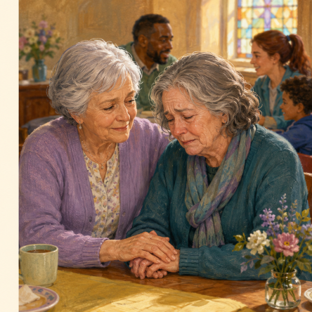
Her grief made her more aware of other lonely people. When someone at church lost a spouse, Grace did not offer easy answers. She sat close, held a hand, and listened. Her attention became one of the most valuable gifts she could give.
The Empty Lot
Behind the little church was an empty lot filled with weeds, rocks, and a broken fence. One Sunday, the pastor asked, “What could this become?”

People offered ideas. Some wanted a playground. Others imagined flowers or a quiet place to sit. Grace said, “We could grow vegetables for the community meal.” Lily suggested a place where children could play. Marcus studied the fence and said, “I could repair that.”
Noah raised his hand. “I can make signs. I’m good at drawing, even if I don’t spell everything right.” Everyone smiled with delight.
They gathered around a simple plan and decided to create a community garden with raised vegetable beds, flowers, benches, and a small play area. No one person could do everything, but everyone could do something. The empty lot gave each of them a place to dedicate time, attention, and talent to something bigger than themselves.
Everyone Brings Something
The garden began with a joyful workday. Marcus repaired the fence and built raised beds. Grace shared what she knew about soil, seeds, and growing vegetables. Lily organized the younger children and made sure everyone had a useful job. Noah painted picture signs and asked an adult to help him spell the words.

Other people brought tools, seeds, food, water, music, and encouragement. Some were strong enough to lift heavy boards. Some were patient enough to untangle roots. Some knew how to organize. Others knew how to listen.
Week by week, the empty lot changed. So did the people working in it. Noah learned that needing help with spelling did not cancel his creativity. Lily learned that she could contribute even when she could not play soccer. Marcus learned that losing his job did not take away his ability to build, love, and serve. Grace learned that grief could open her heart without closing the door on joy.
A Cause Bigger Than Themselves
By spring, vegetables were growing in the raised beds. Children played along the paths. Older people rested on the benches. Flowers attracted butterflies and bees. At the first harvest, the church served soup made with vegetables from the garden.
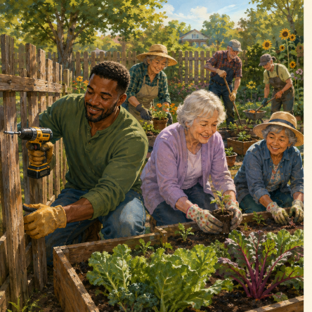
Before the meal, everyone gathered outside with their worn blessing cards. Noah had offered imagination. Lily had offered encouragement. Marcus had offered skill. Grace had offered wisdom and attention. None of them had fixed the whole world. They had simply offered what they had.
The garden reminded them that the good life was not built from happiness alone. It included gratitude and grief, success and failure, strength and vulnerability. It meant knowing you were loved when you struggled. It meant allowing suffering to deepen you without letting it harden you. It meant paying attention to who you were being, not only to what you were achieving.

Noah still misspelled words. Lily’s knee took months to heal. Marcus continued looking for work. Grace still missed Henry. The blessing did not show them how to avoid every difficult road. It showed them how to travel that road together—and how, along the way, to live the good life.

How might we journey together to The Good life by using the twelve lines of the blessing?
Postscript: Dear Readers, I hit the wrong button and published this prematurely. I was just messing around and had not fully figured out how to share this story and blessing and undergirding research, but here it is already out there and published. One of the pieces I had hoped to mention is that the blessing helps us self-regulate and self-regulation is one of our biggest problems and greatest opportunities for growth. I also use the blessing most nights to put myself to sleep as I offer it for myself and others. I hope you will find it useful. Love, June

Comments