At Promise: The Healing Power of a Few Better Words
Updated: Jan 24
“Even broken bones, it is said, have been known to unite at the sound of his voice.”—George Bernard Shaw, The Doctor’s Dilemma

Sometimes the most powerful thing we can do—if we are in leadership, teaching, parenting, mentoring, coaching, or caregiving—is not what we think. Not a new program. Not a better plan. Not another strategy.
Sometimes the most powerful thing we can do is change a word or two.
My friend Dr. Gene Sharratt, on his way to attend Cashmere’s Vale Elementary School National Title 1 award, told me a story about another national Title 1 award-winning school. These awards recognize academic excellence in schools serving a significant number of children from low-income households.
As Gene described it, one of the final steps before an award is considered is a site visit. Interviewers arrive with clipboards, observing not only what a school does, but what it believes about its students.
In this story, the interviewer asked a question that sounds perfectly normal in our culture: “Where are the at-risk students?”
The principal stopped him immediately. Calmly and clearly she said, “Our students are not at risk. They are at promise.”

At promise.
It wasn’t a slogan. It wasn’t a marketing phrase. It was an intentional act of culture-building. Then she did something even more brilliant. She asked the interviewer to finish the sentence:
“Students are at promise of what?” The interviewer answered, “Success.” Then she asked him to finish the other sentence: “Students are at-risk of…?”
He replied, “Failure.”
Two phrases. Two futures. Two outcomes hiding inside everyday language.
We may not realize it, but our words often finish the sentence for us. And then people live inside the ending.
“At-risk” is not a neutral phrase. It carries an emotional forecast. It signals danger. It sets the nervous system on alert. It can quietly lower expectations while pretending to be compassionate. It suggests that trouble is already underway and that the most likely ending is disappointment.
“At promise,” on the other hand, is the language of possibility. It’s the language of investment. It says, “Yes, you may be struggling, but you are not doomed. You are still becoming.”
The interviewer, however, still didn’t fully understand what the principal was protecting. He asked next if he could visit the “needy” students.
And again, the principal refused to let the culture be hijacked by a word that shrinks identity. She replied, “We do not have needy students at our school. Our students are worthy, not needy.”
Worthy, not needy.
That is not mere kindness. It is not sentimental. It is strategic.
Because “needy” suggests burden. It suggests deficiency. It suggests a person should apologize for having needs at all. It becomes a label that can wrap around the soul like a tight sweater—constricting, itchy, hard to breathe in.
But “worthy” restores something many people lose early in life: the felt sense that they matter. That their needs do not cancel their value. That they do not have to be “fixed” in order to belong.

The principal explained her approach simply: language drives expectations, and expectations—when paired with support—drive behavior and performance. When expectation and support are braided together, something powerful happens in a human being: they rise up.
That’s true in schools, but it’s also true in families and churches. It’s true in workplaces and teams. It’s true in friendships and marriages. And maybe most quietly—and most powerfully—it’s true in the private place where we speak to ourselves.
Many of us are not only listening to the voices around us in the present. We are also listening to the voices we collected across a lifetime: teachers, pastors, coaches, parents, bosses, older siblings, and authority figures who carried enormous power in our lives. Some were kind. Some were champions. But many of us have also had what I would call “bad wizards.”
Wizards are people who, because of their position, felt larger than life. They could shape your identity with a look. They could bless you—or break you—with a sentence. And if their voice was harsh, mocking, shaming, dismissive, or constantly disappointed, it didn’t just hurt your feelings. It shaped what you believed was possible for you. It taught you, without saying it directly, what kind of future you were allowed to have.
This is why the Pygmalion Effect matters so much. It describes something many of us have lived: when a powerful person believes in you, expects more of you, and speaks to you as capable, you tend to rise toward that expectation. And when a powerful person expects less, predicts failure, or treats you as a problem, you often shrink.
Over time, those wizard voices can become internal. The bad wizard doesn’t even have to be in the room anymore, because the voice keeps going. This is why grown adults—capable adults—sometimes still feel like anxious children inside. The old script is still running.
And the damaging script often doesn’t sound dramatic. It sounds responsible. It shows up in phrases we almost never question:
“I should do that.” “I have to do that.” “I need to do that.” “I must do that.” “I ought to do that.”

Those phrases can sound mature, even virtuous. But inside the body they often create tightness, resentment, dread, and fatigue. They trigger the feeling of being trapped. And pressure—whether it comes from a boss, a parent, a teacher, or our own inner critic—rarely produces the kind of steady, sustainable growth we actually want.
It produces shutdown. Avoidance. Procrastination. Numbing. Sometimes rebellion.
Now listen to how different life feels when we change the language just slightly:
“I choose to do this.” “I want to do this.” “I get to do this.” “I’m committed to this.” “This matters to me.” “This is aligned with who I want to become.”
Language that returns choice to a person restores energy. It restores dignity. It restores the sense of being a participant in your own life rather than a prisoner inside it.

A Harvard doctor named Matthew Budd wrote about this in his book You Are What You Say. He described meeting Chilean thinkers Humberto Maturana and Fernando Flores, who believed that language doesn’t merely describe reality—it helps generate it. Budd admitted the idea irritated him at first, until Flores decided to prove it with a room full of people.
Flores asked everyone to speak words of despair out loud together—strongly, as if those words were vibrations entering their bodies. The phrases were bleak and hopeless, and Budd wrote that he could feel his mood and body change. His chest became heavy. His personal problems suddenly felt bigger, closer, more ominous. Then Flores asked the simplest question: in that mood, what actions are you likely to take?
Not creativity. Not connection. Not courage.
More likely withdrawal, despair, and quick relief.
Flores made the point clear: your speaking has changed your body, your mood, your physiology, and your possibilities for action.
It’s a stunning idea, and also completely obvious once you’ve lived it.
We are harmed—and healed not only by others' words—but by our own words.
Our language shapes our emotional climate. Our emotional climate shapes our physiology. Our physiology shapes our choices. Our choices shape our lives.
This is why it matters whether we call a child “at-risk” or “at promise.” It is why it matters whether we call people “needy” or “worthy.” And it is why it matters whether we speak to ourselves in the language of tyranny or the language or of choice.
Here are a few simple word swaps that can change stress, energy, and a sense of choice. Keep your own eye out for more. I'll only share a few.
Instead of saying “I should…”, switch to “I could…” or “I want to… or “This matters to me because…”
Instead of saying “Everything is falling apart”, say “Something needs attention.”
Find the words of what you inner champion might say like:
When you’re overwhelmed: “Okay. This is a lot. I don’t have to fix everything today. I only need the next right step—and I can do that.”

This is where language becomes more than communication. The words we speak are never only words—they are atmosphere. They are culture. They are expectation.
Every time we choose language that restores dignity—worthy, not needy… at promise, not at risk… choose, not should—we are not just improving our mood. We are strengthening resilience. We are widening our possibilities for action.
So may we become the kind of person whose words are medicine and encouragement like the teachers at these schools including our own Vale Elementary School here in Cashmere, Washington. A hearty HOORAY and congratulations! (Look for media coverage and celebrate with them.) Good wizards.
And if today we can do only one thing, may it be this: at least, be mindful, notice a few words that might be ready for a lift. And if you dare, change one or two of your words, because sometimes better words are where healing begins.
How might we journey together toward the good life by changing a word or two?
Three people who have been doing good word work for years: Dr. Gene Sharratt on the right - a huge spreader of uplifting, encouraging, I-believe-in-you words particularly in education and business, Dr. Gerald Gibbons in the center who has been spreading strong, resilient, and adventurous words for many decades in numerous spheres especially medicine (believe it or not, he said he was 95!), and Dr. John Darling, my guy who particularly spread loving, healing words for over 40 years in his dental practice. They have touched their families, friends, communities, and larger worlds with their wise and heart-felt messages. Thanks for showing us how it's done. Good wizards.

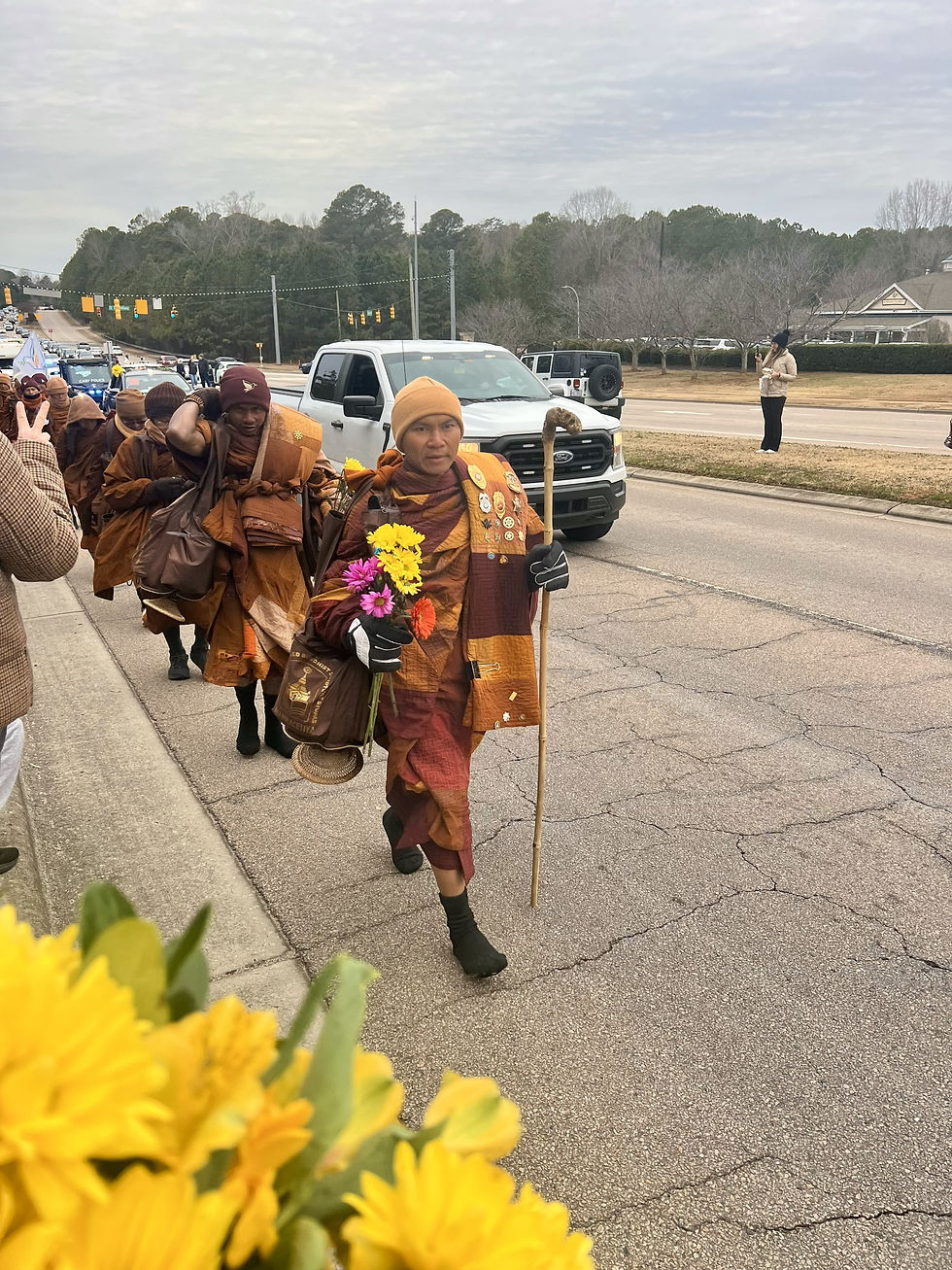
And if you are looking for something uplifting in the national news today. My friend, Gina, shared this picture of the monks marching for peace. Her sister who lives in North Carolina sent it to her. She also shared a video in which the people all along the way are saying to them one after another, "thank you, thank you." So powerful.


Comments